
When you’re pricing items competitively on reselling platforms, understanding the fee structure is non-negotiable. Each platform takes a cut of your earnings, and those fees can make or break your profit margin. Let’s dive into the nitty-gritty of the fee structures for eBay, Poshmark, Mercari, and Depop—four heavy hitters in the reselling game—and see how they stack up.
eBay: The Veteran with Variable Fees
eBay’s been around forever (since 1995!), and its fee structure reflects its complexity as a global marketplace. Here’s the breakdown:
Listing Fees: You get 250 free listings per month for most categories (more if you have an eBay Store subscription). After that, it’s $0.35 per listing. Auctions start at $0.25 if you exceed your freebies.
Final Value Fee: This is where eBay gets you—typically 12.9% of the total sale price (item + shipping) plus a $0.30 per-order fee. Rates vary by category (e.g., 15% for some collectibles, lower for electronics). If you’re above standard seller status or have a store, you might snag a slight discount.
Example: Sell a $20 pair of jeans with $5 shipping? That’s $25 total. eBay takes ~$3.53 (12.9% of $25 = $3.23 + $0.30). Your payout: $21.47 before shipping costs.
Extras: Promoted listings (optional) cost 2-12% extra if they lead to a sale. International sales via the Global Shipping Program add more fees.
Takeaway: eBay’s fees are higher if shipping’s pricey, but the free listings and massive audience (159 million active users) make it a powerhouse for diverse inventory.
Poshmark: The Social Seller with a Flat Cut
Poshmark keeps it simple but takes a hefty slice, aligning with its fashion-focused, social vibe.
Listing Fees: Free—list as much as you want!
Commission Fee: 20% on sales over $15; a flat $2.95 for items $15 or less. No sneaky add-ons for shipping or payment processing—it’s all baked in.
Shipping: Buyers pay a flat $7.97 (USPS Priority Mail), unless you offer discounted shipping ($5.95, $4.99, or free), which cuts into your payout.
Example: Sell a $25 dress? Poshmark takes $5 (20%). You get $20, minus whatever shipping discount you offer. Sell a $10 accessory? They take $2.95, leaving you $7.05.
Note: Poshmark briefly flirted with a buyer-seller split fee in late 2024 (5.99% + tiered $1-$3 fees), but backlash reverted it to the classic 20% by October 21, 2024.
Takeaway: High fees, but the simplicity and built-in community (over 80 million users) make it a go-to for trendy fashion flips.
Mercari: The New Kid with Flexibility
Mercari’s fee structure is straightforward and lighter than Poshmark’s, appealing to sellers with varied inventory.
Listing Fees: Free—no cap on how many items you can post.
Selling Fee: 10% of the item price (not including shipping).
Payment Processing Fee: 2.9% + $0.50 per sale, applied to the total (item + shipping if buyer pays shipping).
Shipping: Seller’s choice—offer free shipping (you pay) or charge the buyer. Mercari provides discounted labels, but costs vary by weight.
Example: Sell a $30 jacket, buyer pays $5 shipping. Mercari takes $3 (10% of $30) + $0.65 (2.9% of $35 + $0.50) = $3.65. You get $26.35 if you cover shipping, or $31.35 if they do.
Withdrawal Fee: $2 to transfer earnings to your bank (optional—you can shop with your balance fee-free).
Takeaway: Lower fees give you pricing flexibility, and the variety (fashion to electronics) suits broad resellers. That $2 withdrawal stings if you cash out small amounts, though.
Depop: The Trendy Upstart with a Fee Shift
Depop’s got a youthful, vintage-loving crowd, and its fees recently got a makeover.
Listing Fees: Free—post away!
Selling Fee: As of July 15, 2024, Depop dropped its 10% commission for new listings. Rejoice!
Transaction Fee: 3.3% + $0.45 per sale (U.S. rates), covering payment processing. Applies to the total (item + shipping if you charge for it).
Shipping: You set it—use Depop’s labels or your own. Costs depend on carrier and weight.
Example: Sell a $25 shirt, $5 shipping. Depop takes $1.28 (3.3% of $30 = $0.83 + $0.45). You keep $28.72 if covering shipping, or $33.72 if not.
Optional: Boosted listings (10% extra if they sell) can bump visibility.
Takeaway: Depop’s fee cut makes it a profit-friendly choice for fashion-forward sellers, especially with its global reach (35 million users in 150 countries).
*Comparing the Costs: A Quick Cheat Sheet
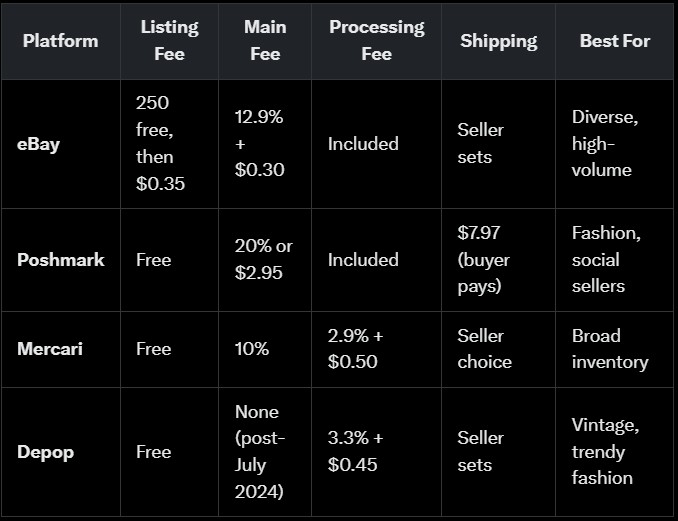
How Fees Impact Your Pricing Strategy
eBay: Factor in that 12.9% + $0.30 when pricing—great for auctions where buyers bid up rare items, less ideal for low-cost goods.
Poshmark: The 20% chunk means you need to price higher to hit your profit target. Bundle deals with flat shipping can offset this.
Mercari: Lower fees let you undercut competitors, but watch shipping costs if you go the “free” route.
Depop: Minimal fees post-2024 give you room to price competitively or pocket more—perfect for niche, high-demand pieces.
The Bottom Line
Your ideal platform depends on what you’re selling and how much effort you’ll put into pricing. eBay’s a beast for volume and variety but chews into profits. Poshmark’s high fees are offset by its engaged fashion crowd. Mercari’s balance of low fees and flexibility suits casual resellers, while Depop’s fee-free shift is a game-changer for trendy flips. Know your costs, test your prices, and watch those margins grow!
 Ania's Finds
Leave a comment